

ReadME [About Triveni-net]
Project Triveni-Net
Tagline: “Sky, Data, and People united for living rivers.”
Mission: To rejuvenate the Mahanadi and Kaveri rivers through AI/ML tech.
Constraint: Low cost, fast development MVP/POC
Innovation Strategy. Leveraging advanced AI/Computer Vision expertise to automate monitoring without expensive hardware sensors.
Triveni-Net is a three-part river intelligence system that unites satellite vision, open data, and citizen power to protect and heal India’s sacred rivers
At its core are three sibling projects:
- Satya-Setu (The Bridge of Truth) A data aggregation and anomaly detection dashboard that unifies fragmented government and public water-quality data (CPCB, SPCBs, Namami Gange, India-WRIS, data.gov.in, and more) and highlights “Truth Gaps” between official claims and actual river conditions.
- Nadi-Drishti (The Vision of the River) A satellite-based remote sensing system that uses free imagery (Sentinel-2, Landsat-8/9) and AI to detect turbidity, algal blooms, pollution plumes, and land-use change, creating a digital twin of river health from orbit.
- Jan-Prahari (The Citizen Sentinel) A WhatsApp-based, AI-verified reporting bot that turns citizens into human sensors, collecting geo-tagged photos of foam, plastic, and other pollution to build a real-time ground map of river abuse and cleanup needs.
Together, these three tools form Triveni-Net: the sky watching, the data auditing, and the people witnessing—all working in sync to make Indian rivers cleaner, safer, and more accountable.
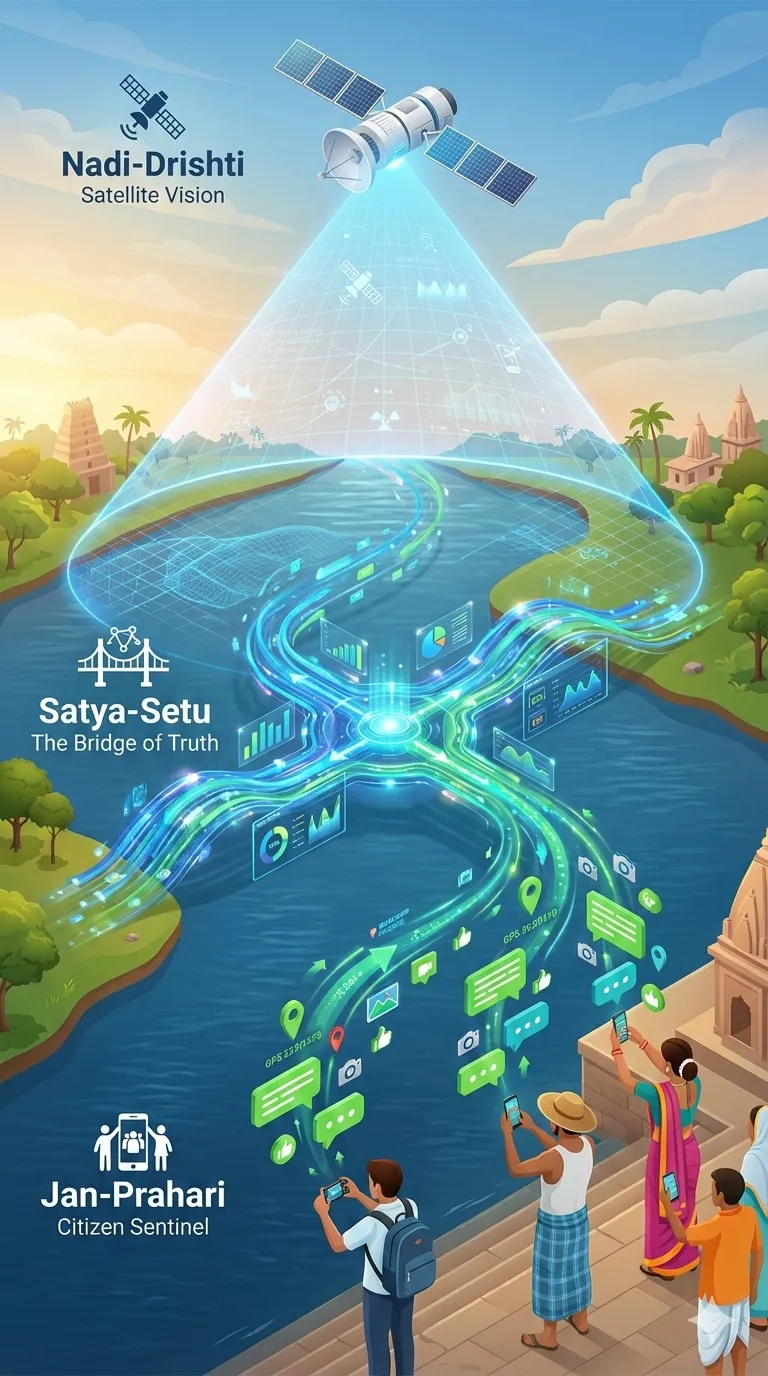
Read in-depth about 3 projects
- Nadi-Drishti eye in the sky: a satellite-based system for river health.
- Jan-Prahari eye on the ground: a WhatsApp-powered citizen sentinel for on-ground evidence
- Satya-Setu bridge of truth: a centralized intelligence dashboard designed to unify fragmented river and pollution data from multiple Indian government and public sources
Three Eyes of Truth: How Nadi-Drishti and Jan-Prahari Strengthen Satya-Setu
Section titled “Three Eyes of Truth: How Nadi-Drishti and Jan-Prahari Strengthen Satya-Setu”Following points explains, in simple language, how our three tools work together to protect holy rivers: Satya-Setu reads official data and exposes gaps, Nadi-Drishti watches the river from the sky, and Jan-Prahari listens to people on the ground. Through five clear points, it shows how combining government numbers, satellite vision, and citizen reports creates a powerful “Bridge of Truth” that makes pollution harder to hide and honest river healing easier to plan
1. Who gives information to whom?
Section titled “1. Who gives information to whom?”- Nadi-Drishti helps Satya-Setu see the whole river Nadi-Drishti is like a pair of eyes in the sky that keep watching the river from space and tell Satya-Setu, “This stretch looks clean, this stretch looks dirty, this place is changing colour.” So Satya-Setu is not depending only on what government sensors say; it also hears directly from the river’s appearance.
- Jan-Prahari helps Satya-Setu hear people on the ground Jan-Prahari is like a direct phone line from citizens to the river system: people send WhatsApp photos and locations whenever they see foam, plastic or dead fish. Satya-Setu then gets these as “real-world incidents” on its map, so it knows exactly where people are actually suffering or seeing pollution.
- Result for Satya-Setu Instead of being a tool that only reads official websites, Satya-Setu becomes a living system that listens to government + sky + people together.
2. How Nadi-Drishti makes Satya-Setu’s warnings smarter
Section titled “2. How Nadi-Drishti makes Satya-Setu’s warnings smarter”- Catching hidden lies or mistakes If government data says “water is fine here” but Nadi-Drishti’s satellite view shows the water looking dark, muddy or green with algae, Satya-Setu can clearly say, “Something is wrong here.” If satellite images show clean water but the sensor numbers look extremely bad for many days, Satya-Setu can suspect the sensor is broken or not updated.
- Judging which stations to trust Over time, Satya-Setu can notice: “This station usually agrees with what the satellite shows, that one often doesn’t.” So each government station gets a kind of trust score , helping activists and officials see whose readings are believable and whose are doubtful.
- Finding long-term danger zones Nadi-Drishti can show which river stretches look bad again and again (chronic pollution) and which only suffer sometimes (after a specific discharge or event). Satya-Setu then highlights these places so clean-up efforts can focus where the river is being abused regularly, not just once.
3. How Jan-Prahari gives Satya-Setu ground truth
Section titled “3. How Jan-Prahari gives Satya-Setu ground truth”- Turning citizen complaints into proof When Satya-Setu detects a suspicious area (for example, satellite shows dirty water but official data claims “good”), it can check: “Did citizens send any photos from here?” If many people have reported foam, plastic or dead fish from that spot, Satya-Setu can label it as a high-confidence problem , supported by real photos and locations.
- Building a story over time On one stretch you might see this pattern: “Day 1: satellite shows change in water; Day 3: citizens report dead fish; government numbers didn’t change.” This kind of timeline helps you tell a clear story to media, courts or community leaders about what actually happened in the river.
- Keeping the citizen data clean Jan-Prahari already filters out “Good morning” messages and selfies using AI, so Satya-Setu only sees genuine pollution reports, not random noise. That means every red dot on Satya-Setu’s map backed by Jan-Prahari is serious and worth attention.
4. How the combined dashboard helps non-tech people act
Section titled “4. How the combined dashboard helps non-tech people act”- One simple map for everyone In Satya-Setu, you can switch on three layers: official numbers, satellite view (Nadi-Drishti), and citizen reports (Jan-Prahari). When you click on any hotspot, you can see: “What does the government say, what does the sky see, and what are people reporting here?” in one place.
- Easy-to-share river stories Satya-Setu can turn complex data into simple cards like: “Here the government says ‘moderate’, satellite sees high pollution, and 12 local people reported foam this week → this stretch is likely underreported.” These cards are easy to show in a meeting, a PIL, a newspaper article, or a satsang talk, so normal people can understand and feel the truth of the river’s condition.
5. Why this trio is powerful for our mission
Section titled “5. Why this trio is powerful for our mission”- Nadi-Drishti makes sure no part of the river is invisible , even remote stretches.
- Jan-Prahari makes sure no citizen’s pain is ignored , turning their phone into a voice for the river.
- Satya-Setu brings all of this together to challenge false claims and demand honest action for the river’s health.
6. We are going to connect Kosh to Triveni Net
Section titled “6. We are going to connect Kosh to Triveni Net”- We will be connecting Triveni Net to the Kosh.
- We will be creating a live component. That time, we will have live data and visuals.