

How a Clean River Slowly Turns Dirty: The Journey of a Water Drop
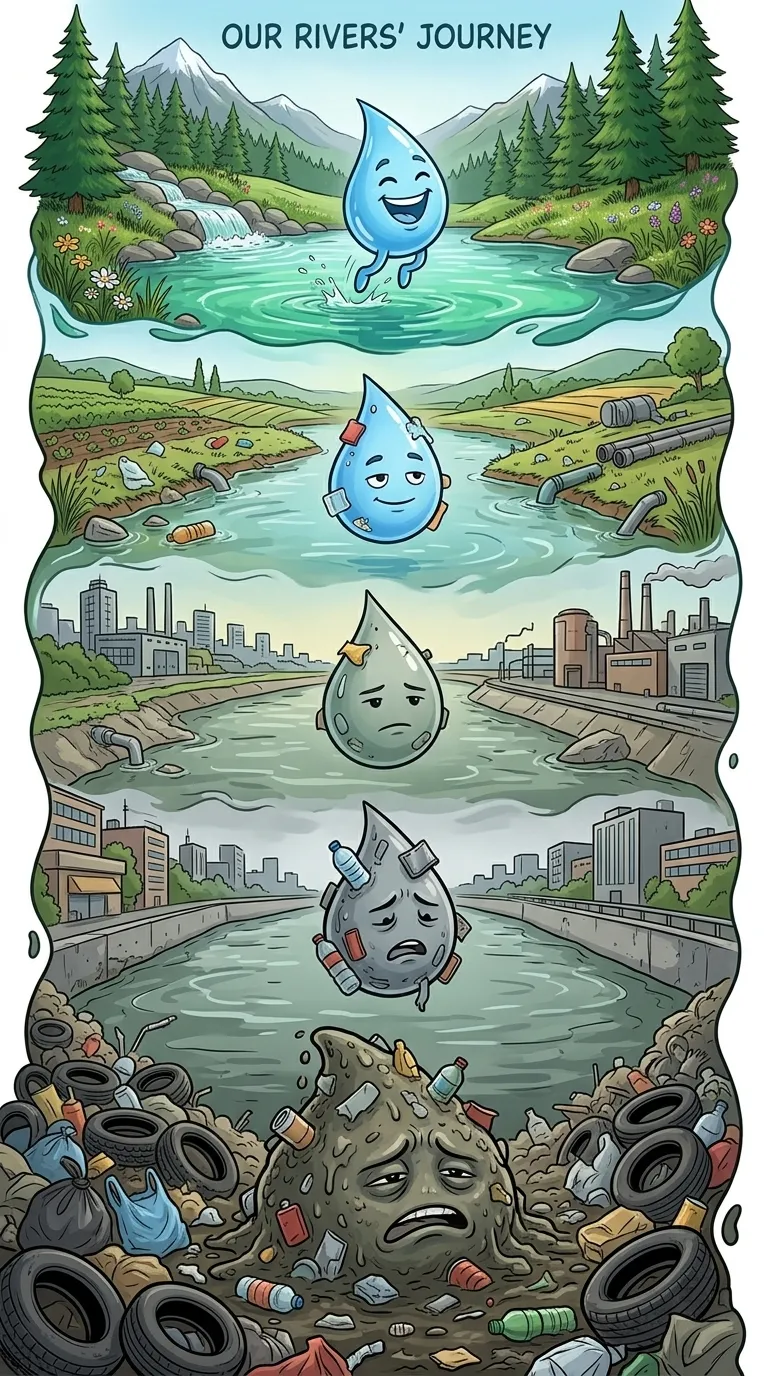
It is almost impossible to stand beside a dark, heavy, slow-moving urban river and imagine that the water was once young, fast, and remarkably pure. We often view river pollution as a static state—something a river simply is. But pollution is a process. It is a slow, accumulating tragedy that unfolds mile by mile.
To truly comprehend how our rivers break down, we must stop looking at the river as a single massive body of water. Instead, we need to zoom in. We must follow the intimate, physical journey of a single drop of water.
By tracking this drop from its birthplace to its final destination, we can witness the exact moments a living system slowly turns into a toxic drain.
The Mountain Cradle: Breath and Life
Section titled “The Mountain Cradle: Breath and Life”Our drop’s journey begins high in the craggy peaks, born from the slow melt of a winter glacier.
At this moment, the water is freezing, crystalline, and alive. As the drop tumbles over polished mountain stones, it churns and traps air.
The water here is not completely empty—it carries natural minerals and tiny particles of earth—but it is perfectly balanced. If you cupped your hands and drank from the stream, the water would taste crisp and faintly sweet. It is a pristine system, untouched by human hands. But gravity pulls our drop downward, out of the protective mountains and into the populated plains.
The Agricultural Plains: The First Taint
Section titled “The Agricultural Plains: The First Taint”As the gradient softens, the river widens and slows. The rugged forests give way to vast, geometric grids of agricultural farmland. Here, the river provides life, irrigating crops that feed millions.
But this is where our water drop suffers its first invisible blow. After a heavy monsoon rain, water washes off the nearby fields and trickles into the river. This runoff carries invisible traces of synthetic nitrogen fertilizers and chemical pesticides.
When our drop absorbs these chemicals, it doesn’t change color. It doesn’t smell foul. To the naked eye, the river still looks beautiful. Yet, the chemistry of the water has fundamentally shifted. The excess nutrients act like a steroid for algae, sparking microscopic blooms that will later suffocate the natural plant life. The water has lost its virgin purity.
How Rivers Become Polluted: A Learning Roadmap
We will explore the different ways human activity affects river systems, step by step.
- 1Article 4
Where Does River Pollution Come From?
Understand the major sources of river pollution including sewage, industrial waste, and agricultural runoff.
The Urban Collision: The Weight of the City
Section titled “The Urban Collision: The Weight of the City”Leaving the quiet farms behind, our drop enters a sprawling urban metropolis. The dirt banks are replaced by concrete embankments, and the gentle hum of the forest is drowned out by the roar of city traffic.
Suddenly, the river is assaulted from all sides. A massive, dark nalla (open drain) violently intersects with the main current. Our water drop is instantly swallowed by millions of gallons of untreated domestic sewage. The temperature of the water artificially spikes. The crisp, oxygen-rich environment is replaced by a murky, grey-black soup smelling of sulfur and human waste.
Bacteria in the sewage immediately begin consuming the remaining oxygen to break down the organic matter. Our drop is now suffocating. Floating alongside it are the indestructible ghosts of city life: plastic bags, synthetic floral offerings, and multi-layered food wrappers.
How Pollution Flows Into Rivers
The Industrial Gauntlet: A Chemical Cocktail
Section titled “The Industrial Gauntlet: A Chemical Cocktail”Just past the dense city center, our water drop flows through an industrial corridor. Heavy manufacturing plants, textile dye houses, and tanneries line the banks.
Hidden pipes beneath the water’s surface pump hot, untreated industrial effluent directly into the current. Our drop is infused with heavy metals like lead and chromium, along with synthetic dyes that stain the surrounding water a sickly, unnatural red or foamy white.
The water is now highly toxic. It has become a hazard to the very people and animals that rely on it. The fish that survive here absorb these heavy metals into their flesh, and the farmers downstream who use this water will unknowingly spray these chemicals onto their food crops.
Reaching the Sea: The Heavy Burden
Section titled “Reaching the Sea: The Heavy Burden”Weeks after it first melted from a pristine glacier, our exhausted water drop finally meets the ocean at the river’s estuary.
It is no longer the crisp, clear bead of water that tumbled over mountain rocks. It is heavy, carrying the combined sins of agriculture, urbanization, and industrialization. It disperses into the sea, taking its toxic burden with it.
Following this single drop teaches us the most important lesson in river conservation: Pollution is cumulative. No single village, city, or factory destroyed the river on its own. It was a collective failure.
But within this tragedy lies our greatest hope. Because a river flows, it is constantly flushing itself out. If we tackle pollution step-by-step, the river can heal:
- At the Farms:: Intercept agricultural runoff by using natural buffer zones and organic farming methods.
- At the City: Build and maintain high-capacity treatment plants so no raw sewage enters the nallas.
- At the Factory: Strictly regulate industrial pipes with zero-liquid-discharge policies.
If we take these steps, the next drop of water falling from the mountain can stay pure, all the way to the sea.
Quick Knowledge Check
0/5 answered
What is the largest source of river pollution in many cities?
Select an answer to continue
🔗 This builds on concepts from: Why Our Rivers Are Polluted? - Article 3: Why Clean Rivers Matter to Our Lives and Dharma.
🔗 Coming next in the series: Article 5: Different Kinds of River Pollution: What You Can See and What You Can’t, where we will unpack the specific differences between natural silt, visible trash, and invisible chemicals.
