

What Is a River, Really? A Living System, Not Just Water Flowing
When you think of a river, what comes to mind? Most of us picture water flowing in a channel—maybe a wide, slow river like the Ganga near Varanasi, or a narrow, muddy drain cutting through a city neighborhood. We see the surface, the visible water, and assume that’s all there is.
But here’s the truth: a river is not just water flowing in a channel. A river is a massive, interconnected living system—a body with veins, lungs, and a heartbeat. It breathes. It cleans itself. It supports thousands of species. And most surprisingly, much of what makes a river alive happens invisibly, beneath the surface and far beyond the banks.
Before we can understand how rivers get polluted, we need to understand what a river actually is. Let’s discover the hidden anatomy of a river—from the mountains where it’s born to the sea where it finally rests.
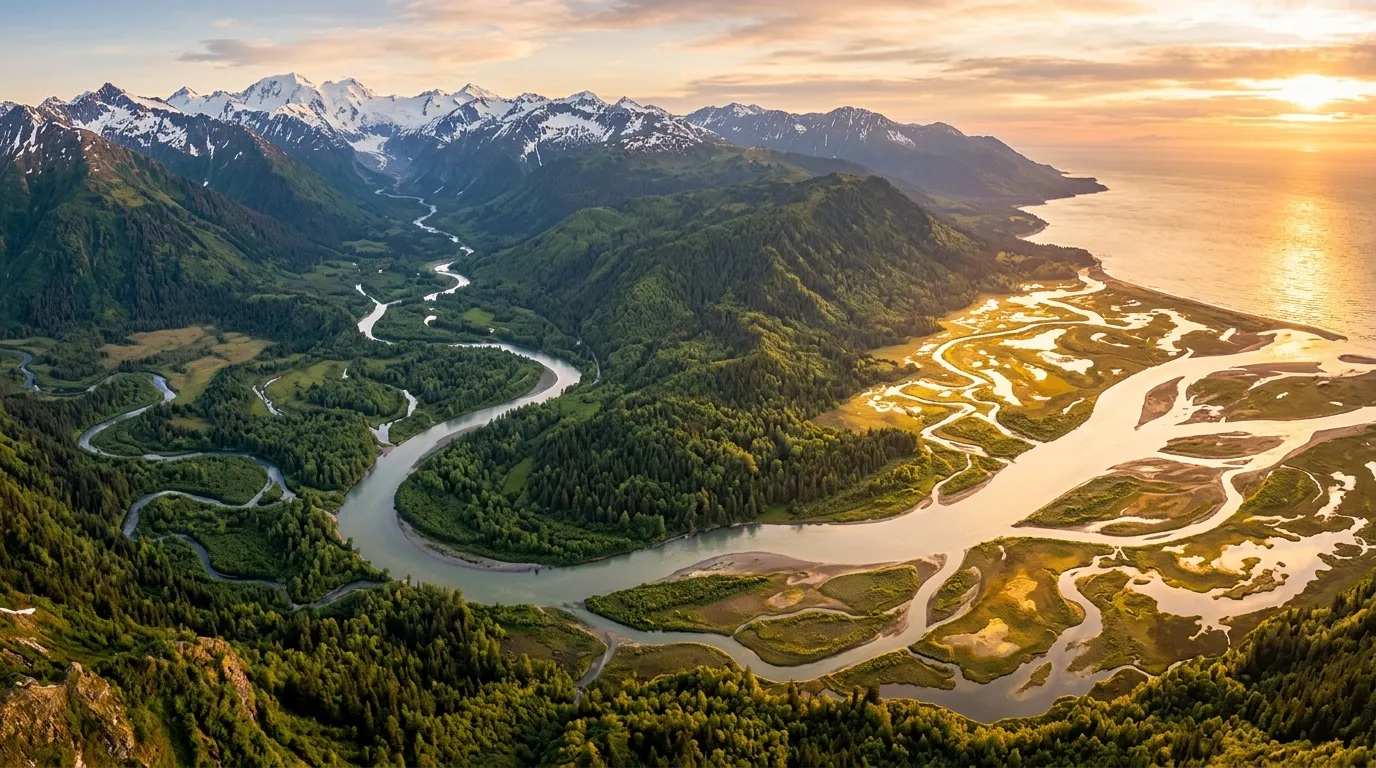
The Common View vs. The Hidden Reality
Section titled “The Common View vs. The Hidden Reality”If you’ve grown up near a city, you might think a river is just a drain—dirty water flowing between concrete walls. If you live near a village, you might see it as a water source, a place to bathe, or wash clothes. Both views are incomplete.
The hidden reality is this: What you see flowing past you is just one part of a much larger system. That water has traveled hundreds or even thousands of kilometers. It has passed through forests that filtered it, rocks that shaped it, and underground aquifers that fed it. The river you see today is the visible result of an entire landscape working together—rain, soil, trees, groundwater, and more.
Think of it like this: when you see a person, you’re looking at skin, hair, and clothes. But beneath the surface is a skeleton, muscles, blood vessels, and organs working together. A river is similar. The flowing water is just the surface. Beneath it lies a complex, living system that most of us never think about.
The Journey: From Mountains to Sea
Section titled “The Journey: From Mountains to Sea”Every river has a life story—a journey from birth to the sea. Let’s follow that journey in four stages, using rivers like the Ganga or Godavari as examples.
-
The Source (Where Rivers Are Born)
Section titled “The Source (Where Rivers Are Born)”High in the mountains—the Himalayas for rivers like the Ganga, Yamuna, and Brahmaputra, or the Western Ghats for rivers like the Godavari and Kaveri—rivers begin as tiny trickles of water. This water comes from:
- Melting glaciers (in the Himalayas)
- Natural springs where groundwater bubbles up through cracks in rocks
- Rain and mist that collect in forest streams
At this stage, the river is cold, clear, and full of oxygen. The water tumbles over rocks, creating white foam. This movement mixes oxygen into the water—like stirring air into a smoothie. Fish and insects that live here are specially adapted to cold, fast-moving water.
-
Tributaries (Gathering Strength)
Section titled “Tributaries (Gathering Strength)”As the river flows downhill, it’s joined by smaller streams called tributaries. Think of tributaries as veins feeding into a larger vein. Each tributary adds water, nutrients, and sediment (tiny particles of soil and rock) to the main river.
For example, the Ganga is fed by tributaries like the Alaknanda, Bhagirathi, Gomti, and Yamuna. The Godavari is joined by the Pranhita, Indravati, and Manjra. By the time these tributaries merge, the river has grown wide and powerful.
-
The Floodplains (Flat Lands and Human Settlements)
Section titled “The Floodplains (Flat Lands and Human Settlements)”When the river reaches the plains—flat, low-lying areas—it slows down. The water spreads out, becomes warmer, and carries more sediment. This is where most human settlements are built. Cities like Prayagraj, Patna, Varanasi, and Haridwar sit on floodplains.
Floodplains are not just land beside the river—they are part of the river system. During monsoon rains, rivers naturally overflow their banks and spread across floodplains. This flooding is not a disaster; it’s how rivers deposit nutrient-rich soil, recharge groundwater, and create wetlands that act as natural filters.
-
The Delta (Where Rivers Meet the Sea)
Section titled “The Delta (Where Rivers Meet the Sea)”Finally, after traveling hundreds or thousands of kilometers, the river reaches the ocean. Here, it slows almost to a stop and deposits all the sediment it has carried. This creates a delta—a fan-shaped area of islands, marshes, and channels.
The Ganga-Brahmaputra Delta (the Sundarbans) is the largest river delta in the world. Deltas are incredibly rich ecosystems, home to mangroves, fish, birds, and even tigers. They also protect coastal communities from storms and erosion.
A River's Journey: From Mountains to Sea
Click a zone on the map to explore.
Now that you’ve seen the visible journey, let’s look at the invisible connections that keep rivers alive.
The Invisible Connections: Rain, Forests, and Groundwater
Section titled “The Invisible Connections: Rain, Forests, and Groundwater”Here’s where it gets fascinating. Rivers are not isolated channels of water. They are deeply connected to three invisible systems: rain, forests, and groundwater. If any of these connections break, the river suffers—or dies.
Connection 1: Rain (The Sky Feeds the River)
Section titled “Connection 1: Rain (The Sky Feeds the River)”Rivers depend on rain. But not in the way you might think. Rain doesn’t just fall directly into the river. Instead:
- Rain falls on mountains, forests, and fields.
- Some of it soaks into the ground and becomes groundwater.
- Some of it flows over the land as runoff and enters streams.
- Some of it is absorbed by trees, which slowly release it back into the soil and air.
This means the health of a river depends on rainfall patterns across the entire landscape, not just along the riverbanks.
Connection 2: Forests (The Lungs and Kidneys of Rivers)
Section titled “Connection 2: Forests (The Lungs and Kidneys of Rivers)”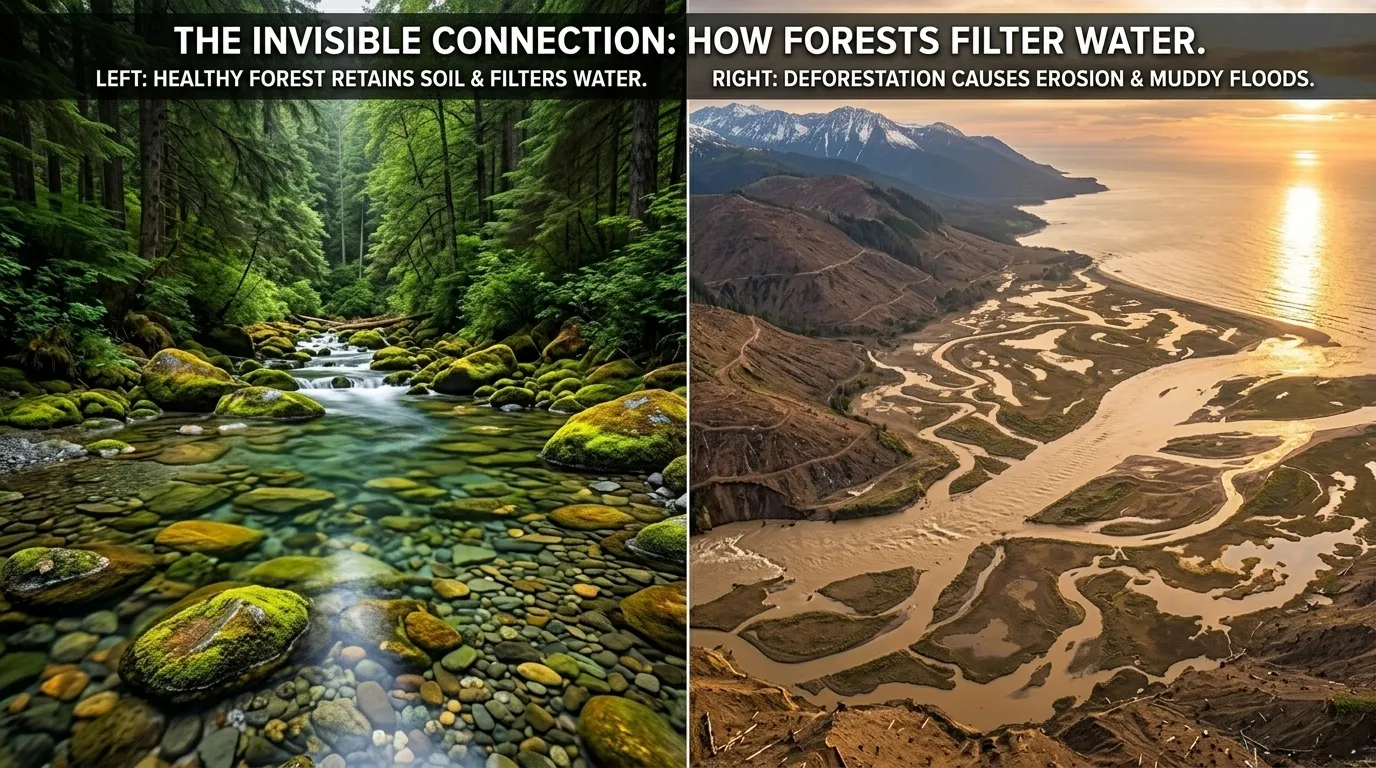
Forests play two critical roles for rivers:
First, they act like sponges. When rain falls on a forest, the soil—rich with roots, leaves, and organic matter—absorbs water slowly. This stored water is released gradually into streams and rivers over weeks and months. That’s why rivers in forested areas continue to flow even during dry seasons.
Second, they act like filters. As water passes through forest soil, the soil traps pollutants, sediments, and excess nutrients. The water that reaches the river is naturally cleaner.
When forests are cut down, rain rushes straight into rivers, causing floods during monsoons and drying up rivers in summer. The soil erodes, filling rivers with mud. The filtering stops, and pollutants flow freely.
Connection 3: Groundwater (The Hidden Reservoir)
Section titled “Connection 3: Groundwater (The Hidden Reservoir)”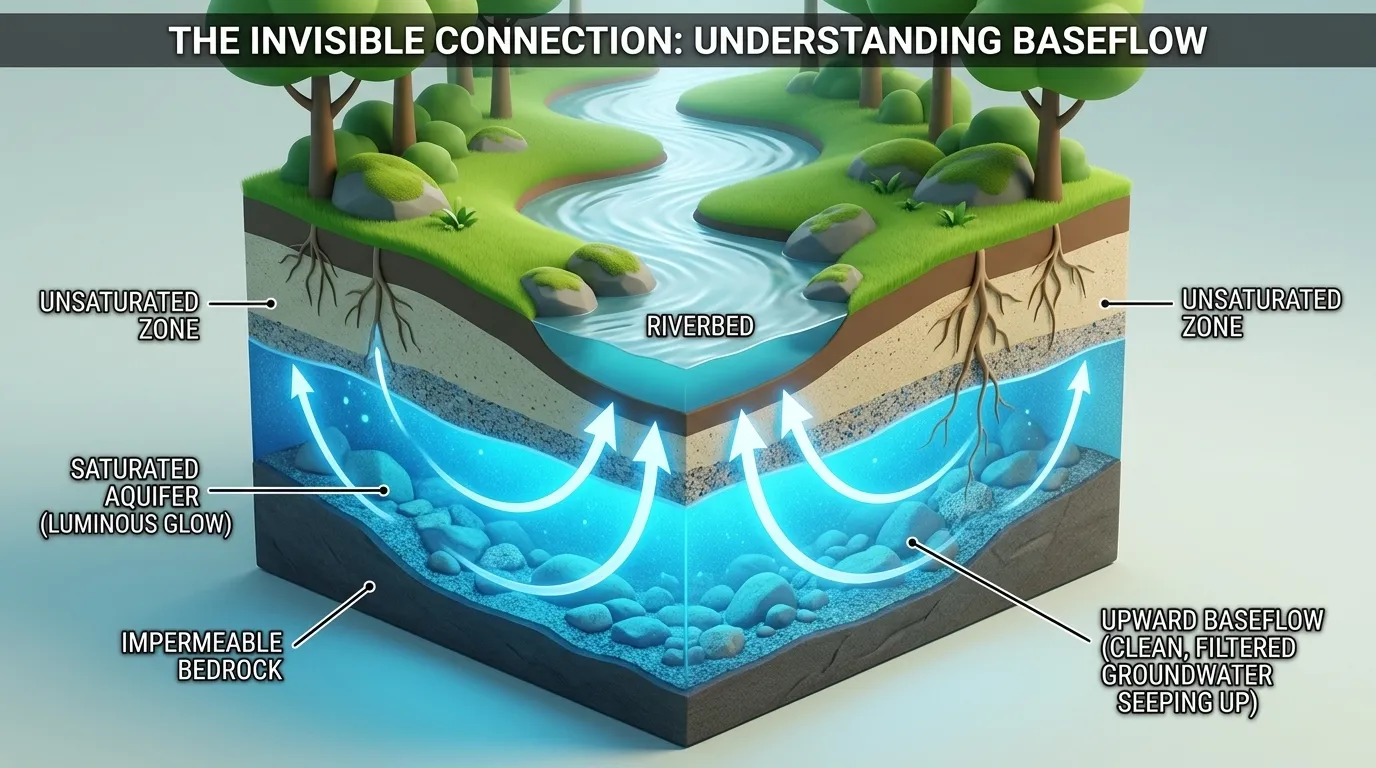
This is the most misunderstood connection. Most people think rivers are just surface water—what you see flowing. But in reality, rivers are often groundwater showing itself above the surface.
Here’s how it works: beneath the riverbed and surrounding land, there are layers of rock and soil soaked with water—this is called the aquifer. When the water table (the top level of this underground water) is high, groundwater seeps upward into the river. This “baseflow” keeps rivers flowing even when it hasn’t rained for weeks.
Conversely, when the river is full during monsoons, some water seeps down from the river into the aquifer, recharging groundwater.
This two-way exchange is critical. If we over-pump groundwater (for farming, drinking, or industry), the water table drops. The river loses its baseflow and starts to dry up. If we block the river with dams, the recharge of groundwater slows down, and wells in nearby villages go dry.
Rivers only flow when it rains.
Click to revealForests and groundwater slowly release water into rivers, helping them flow even during dry months.
Click to flip backWhy This Matters: Preparing to Understand Pollution
Section titled “Why This Matters: Preparing to Understand Pollution”Now that you understand what a river truly is—a living, breathing, interconnected system—you’re ready to understand why pollution is so devastating.
When we dump sewage into a river, we’re not just dirtying water in a channel. We’re suffocating a living body. When we cut down forests, we’re removing the river’s lungs and kidneys. When we over-pump groundwater, we’re draining the river’s lifeblood.
Pollution doesn’t just make water dirty. It breaks the invisible connections that keep rivers alive. It disrupts the delicate balance between rain, forests, groundwater, and the river itself.
In the next article—“Why Clean Rivers Matter to Our Lives and Dharma”—we’ll explore why protecting this living system is not just an environmental issue. It’s a matter of survival, culture, and sacred duty.
The Ganga, the Yamuna, the Godavari—these are not just names on a map. They are ancient, living beings that have shaped our land, our history, and our lives. They deserve our understanding, our respect, and our protection.
